
Who Is Responsible for Property Damage in a Florida Commercial Building?
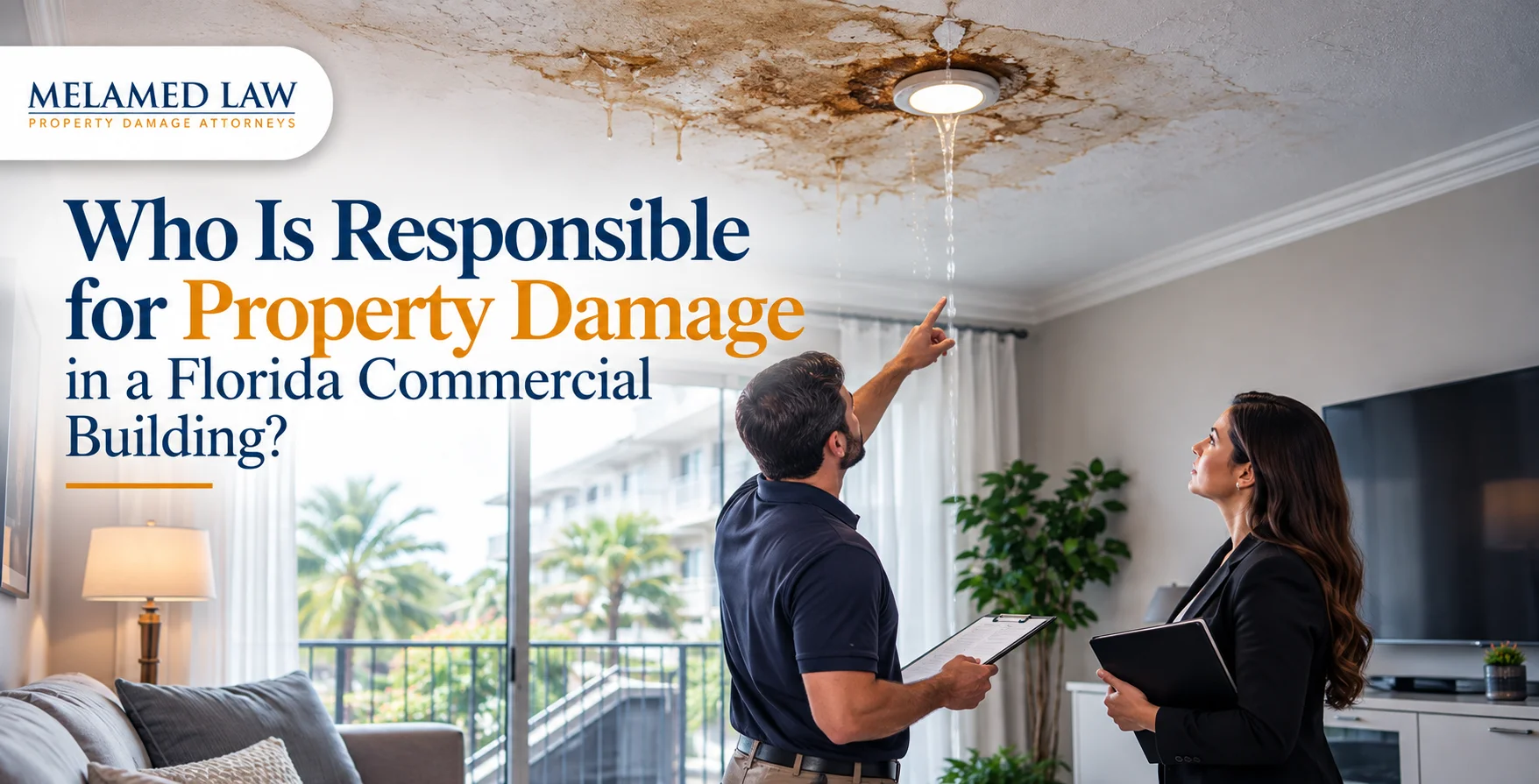
It depends on 3 things. What your lease says. What caused the damage. What your insurance policy covers. Landlords typically handle the structure and shared spaces. Tenants handle their own space, unless the lease says otherwise.
Key Takeaways
- •Florida doesn't have the same protection rule for commercial tenants and residential tenants. A vague lease usually favors the landlord, not the tenant.
- •There's a real window for reporting property damage to your insurer, and it's shorter than most owners assume.
- •Insurers are required to move on your claim within a set number of days. Slow-walking a decision isn't allowed anymore, though it still happens.
- •Handing your claim off to a contractor through an assignment agreement doesn't work the way it used to. You're dealing with the carrier directly now.
- •A landlord can still end up liable for a contractor's error if the landlord knew about the hazard first.
Does Florida Law Make the Landlord Responsible by Default?
Not automatically. This confuses more tenants than anything else in a commercial lease dispute. Residential renters get a fair number of built-in protections. Commercial tenants don't get that safety net. Florida courts lean toward the idea that a landlord only owes a repair duty it clearly agreed to in writing.
There's a well-known case involving a waterfront lease where the tenant assumed the landlord would cover a major structural repair, simply because it seemed obvious. The lease never said so in writing. The tenant ended up paying for it. Common sense lost to contract language.
This is the exact blind spot Melamed Law PLLC helps clients close before it costs them, reviewing lease language line by line so nobody finds out the hard way, mid-storm-season, who's actually on the hook.
What Does the Lease Actually Decide?
The lease carries more weight here than almost anything else. Florida gives landlords and tenants wide latitude to write their own terms.
Some leases push nearly every cost onto the tenant. Others put most of it back on the landlord. Plenty sit somewhere in the middle, and that middle ground is where disagreements usually start.
A strong lease spells out who repairs what, how fast, and what happens to rent if the space becomes unusable. A weak one leaves that all open to interpretation, which is exactly where litigation begins.
Landlord vs Tenant, at a Glance
| Damage Type | Usually Landlord | Usually Tenant |
|---|---|---|
| Roof, structure | If lease says so | If lease is silent |
| Common areas | Usually, yes | Rare, unless triple net |
| Interior build-out | Rarely | Nearly always |
| HVAC, plumbing | Lease-dependent | Lease-dependent |
| Storm loss | Insurance-driven | Insurance-driven |
Who Pays After a Hurricane Actually Hits?
Neither party covers it first, not out of pocket. Insurance does. And Florida tightened the rules on how fast owners need to move after a loss.
Report too late, and a carrier has real grounds to deny the claim outright, even when the damage is completely legitimate. Owners who wait weeks to report, hoping for a cleaner estimate first, routinely end up worse off than owners who call the same day.
Most commercial owners think their lease decides everything. It doesn't. The insurance policy is what actually pays for the rebuild, and the lease only decides who fights that battle. We see owners lose leverage in the first thirty days simply because they didn't know the time was already running.
We see this pattern across nearly every storm season. Clients who bring us in within the first few weeks recover more, and face fewer disputed line items, than clients who wait until the claim already feels stuck.
How Fast Does Your Insurer Actually Have to Respond?
Faster than carriers would like. Florida law no longer lets insurers sit on a commercial claim for months without a decision.
Once you report a loss, the insurer has to acknowledge it, inspect it, and eventually pay or deny it, all within defined timeframes. That timeline used to be looser. It isn't anymore, and that shift favors owners who know how to use it.
Assignment of benefits, the old workaround where a contractor essentially took over your claim on your behalf, doesn't function the way it once did. You're the one negotiating with the carrier now, which means the strength of your documentation and your legal strategy matter more than ever.
That makes the early paperwork especially important. Keep the photos, estimates, invoices, repair records and every message with the insurer in one place. If the carrier underpays or denies part of the claim, those records can become the evidence showing what was damaged, cost and what the policy actually covers.
Can a Landlord Be Liable for a Contractor's Mistake?
Sometimes. Florida generally shields owners from a contractor's own errors. There's a real exception, and it's the one that catches owners off guard.
If a landlord already knew about a hazard, a loose wire, a weak railing, a known leak, and let a contractor walk into that condition anyway, liability can land back on the owner. The independent contractor label doesn't erase that responsibility.
This comes up constantly with roofing crews, HVAC vendors, and water mitigation teams brought in after a storm. Knowing about a risk and doing nothing about it is where owners get exposed.
Property owners can't outsource responsibility just by hiring outside help. If they knew about a dangerous condition and did nothing, that knowledge follows them into court.
What Should You Actually Do the Day You Find Damage?
Document it. Call your insurance company. Hold off on signing anything a contractor hands you on site.
- •Photograph everything before cleanup begins.
- •Pull your lease and read the repair language the same day.
- •Report the loss in writing as soon as possible, not after a full inspection.
- •Skip contractor assignment paperwork until you understand what it actually signs away.
- •Get a professional review before accepting the first number a carrier offers.
This is the process Melamed Law PLLC runs for owners handling hurricane damage, water damage, and disputed or denied claims. Owners who come to us early keep more control than ones who wait for a denial letter to decide things for them.
Damage Already Happened? Don't Wait to Find Out Who Pays.
Melamed Law PLLC reviews your lease, your policy, and your denial letter before you say another word to the adjuster.
Call 954-529-0695 for a Case ReviewFrequently Asked Questions
Can a tenant sue a landlord for lost business income after property damage?
Only if the lease or landlord's negligence supports it. Business interruption losses usually run through the tenant's own policy, not a lawsuit against the landlord.
Does flood damage get covered the same way as hurricane wind damage?
No. Standard commercial property policies exclude flood. You need a separate flood policy, often through the NFIP or a private surplus carrier, to recover flood losses.
What happens if the commercial building is condemned after the damage?
Condemnation typically triggers lease termination clauses. Both parties may lose their claim to the space, and insurance proceeds get distributed based on policy and lienholder priority, not lease terms.
Disclaimer: This article is for informational purposes and is not legal advice for your specific situation. Contact Melamed Law PLLC, which represents commercial and residential property owners throughout Florida in insurance claim disputes.