
Can a Florida Condo Association File an Insurance Claim on Behalf of Unit Owners?
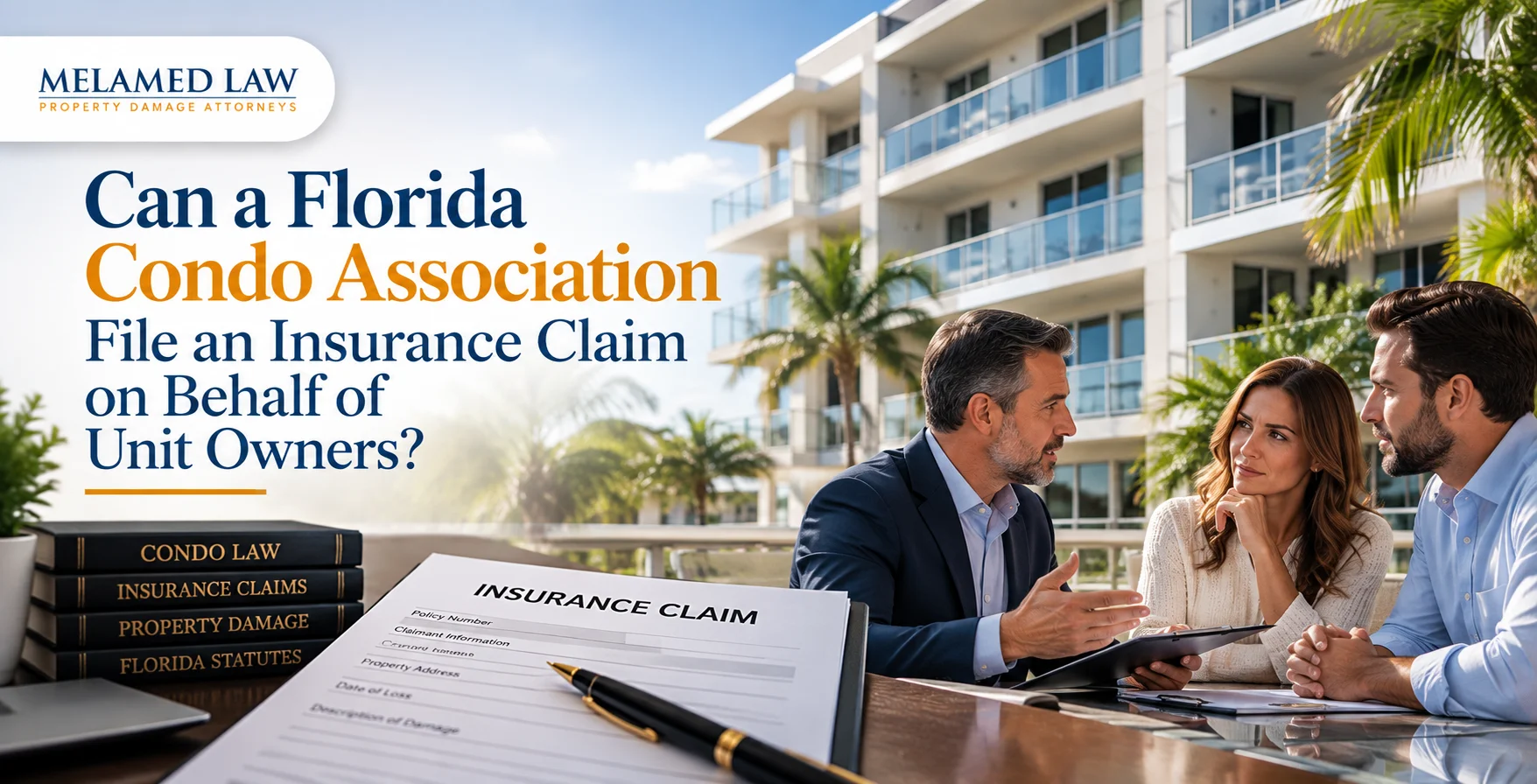
Yes, however, only for damage to the building itself. A Florida condo association can and must file a claim under its master policy for common elements, shared systems, and the structure. It cannot file or collect on a unit owner's personal HO-6 policy.
Key Takeaways
- •Florida Statute requires the association to insure the building, common elements, and shared systems.
- •Unit owners insure everything from the drywall in, plus contents, under a separate HO-6 policy.
- •A board that skips a claim to dodge a premium hike may be breaching its fiduciary duty.
- •Two claims can run at once. One property loss, two policies, two separate filings.
- •Disputes over the board's insurance decisions can go to DBPR arbitration or circuit court.
Who Actually Owns the Duty to File?
The association owns the building. That duty is not optional. Florida Statute 718.111(11) puts the burden on the board: maintain adequate property insurance for the condominium property and file when a covered loss hits it. That's not a suggestion. It's a mandate every association operates under.
A single owner cannot file against the association's master policy. That right belongs to the board, or whoever it authorizes, usually a property manager or public adjuster.
Our surveys of Florida condo cases show the confusion rarely starts with the statute. It starts when owners assume one phone call covers everything.
What Damage Triggers the Association's Master Policy?
Roofs, hallways, elevators, shared pipes, exterior walls. If it's a common element, it's the board's claim to file, not yours.
- •A burst pipe inside a shared wall that floods three units below
- •Wind-driven rain through a failed roof membrane after a named storm
- •A cracked stack line serving multiple floors
The association's carrier takes the lead on any common-element source. The owner's HO-6 handles only what's inside the unit.
Can the Association File for Damage Inside a Private Unit?
Sometimes. It depends on the policy type your building carries. Florida condo buildings generally carry one of two master policy structures: bare walls in or all-in. A bare walls policy stops at the unfinished drywall. An all-in policy extends to original fixtures and finishes installed when the building was built.
Under an all-in policy, the association's claim can reach inside your unit for the original build-out. Upgrades you paid for yourself almost never fall under that umbrella.
| Question | Master Policy (Association) | HO-6 Policy (Unit Owner) |
|---|---|---|
| Who files the claim? | The board or its property manager | The individual owner |
| What it covers | Structure, roof, common elements, shared pipes | Interior finishes, contents, personal liability |
| Who picks the adjuster | The association's chosen carrier and adjuster | The owner's own carrier |
| Flood damage | Separate NFIP or private flood policy required | Separate NFIP or private flood policy required |
| Typical deductible payer | Association, from reserves or a special assessment | Owner, per the HO-6 terms |
Boards that treat the master policy as a formality end up shifting real losses onto owners who had no say in the decision. Authority under 718.111 comes with accountability, not just discretion.
What Happens When the Board Refuses to File a Claim?
Many owners lose the most money here. Boards sometimes skip filing to avoid a premium increase at renewal. They pass a special assessment instead and call it a business decision. It isn't always one they're entitled to make.
Officers and directors owe a fiduciary duty to every member. Declining to file a claim purely to protect next year's premium can breach that duty. Owners who suspect this is happening have real options, including DBPR arbitration under Section 718.1255 or circuit court. Unit owners can request records, review association decisions, challenge improper actions, and pursue available remedies under Florida law.
This is where our practice steps in. When a board stalls or underreports a loss, we push the claim forward.
Stuck Between Your Board and Your Insurer?
If your association is dragging its feet on a claim affecting your unit, don't wait on the next board meeting. Melamed Law reviews the master policy, governing documents, and your HO-6 side by side, then shows you exactly where the gap sits.
Call 954-529-0695 for a free case reviewWhat Should Unit Owners Do If They're Left Out of the Process?
Don't wait on the board's timeline. Your own claim clock is running.
- •Notify your HO-6 carrier immediately, regardless of what the board decides
- •Request the master policy declarations page. Florida law gives 10 business days for a response
- •Document your unit with photos and receipts before repairs start
- •Put every request to the board in writing
- •Track your deadline. Three years for hurricane loss, two years for most other claims
A unit owner who waits on the association to "handle it" often discovers, months later, that nothing was ever filed.
How Melamed Law Approaches These Disputes
Two policies, one loss and a board that may not be moving fast enough. That's where our firm works.
Aaron Melamed built this practice around Florida property damage claims specifically, not general litigation with insurance on the side. That focus matters when a case turns on reading a declaration of condominium against a master policy, then lining it up with the owner's HO-6 terms.
Most owners come to us after the board has already made a decision they weren't part of. Our job is figuring out whether that decision was lawful, and if it wasn't, making the association fix it.
The firm reviews governing documents, master policy declarations, and denial letters together to determine whether the association met its statutory duty. For claims tied to a shared building system, the firm's water damage claims page covers the most common condo scenario.
Storm-driven losses follow a similar pattern, explained on our hurricane damage claims page. When the dispute is about how the insurer handled the claim rather than coverage itself, our bad faith claims practice page explains what that looks like.
Protecting Your Claim When Two Policies Are Involved
- •Read your declaration of condominium before a loss happens
- •Confirm whether your building carries bare walls or all-in coverage
- •Keep your HO-6 limits updated as renovation costs climb
- •Ask your board, in writing, for its claims-handling policy
- •Get a second opinion before accepting a low settlement offer
Our related piece on water damage responsibility in Florida condos goes deeper into liability splits when the source isn't obvious.
Frequently Asked Questions
Does the association's claim affect my individual premium?
No. Your HO-6 premium is set by your own carrier and your own claims history, not the association's.
Can I sue the association directly over a denied master policy claim?
Sometimes, but Florida often requires DBPR arbitration first for disputes about the board's authority or handling.
What if the association's insurer goes insolvent mid-claim?
The Florida Insurance Guaranty Association steps in, covering losses up to statutory limits for the affected policy.
Let Melamed Law Sort Out the Coverage Gap
Melamed Law reads the fine print for a living. Call for a free, no-obligation case review.
Call 954-529-0695 | Se Habla Español | Free Case ReviewDisclaimer
This blog is informational purposes only. For additional information, please contact Melamed Law.